

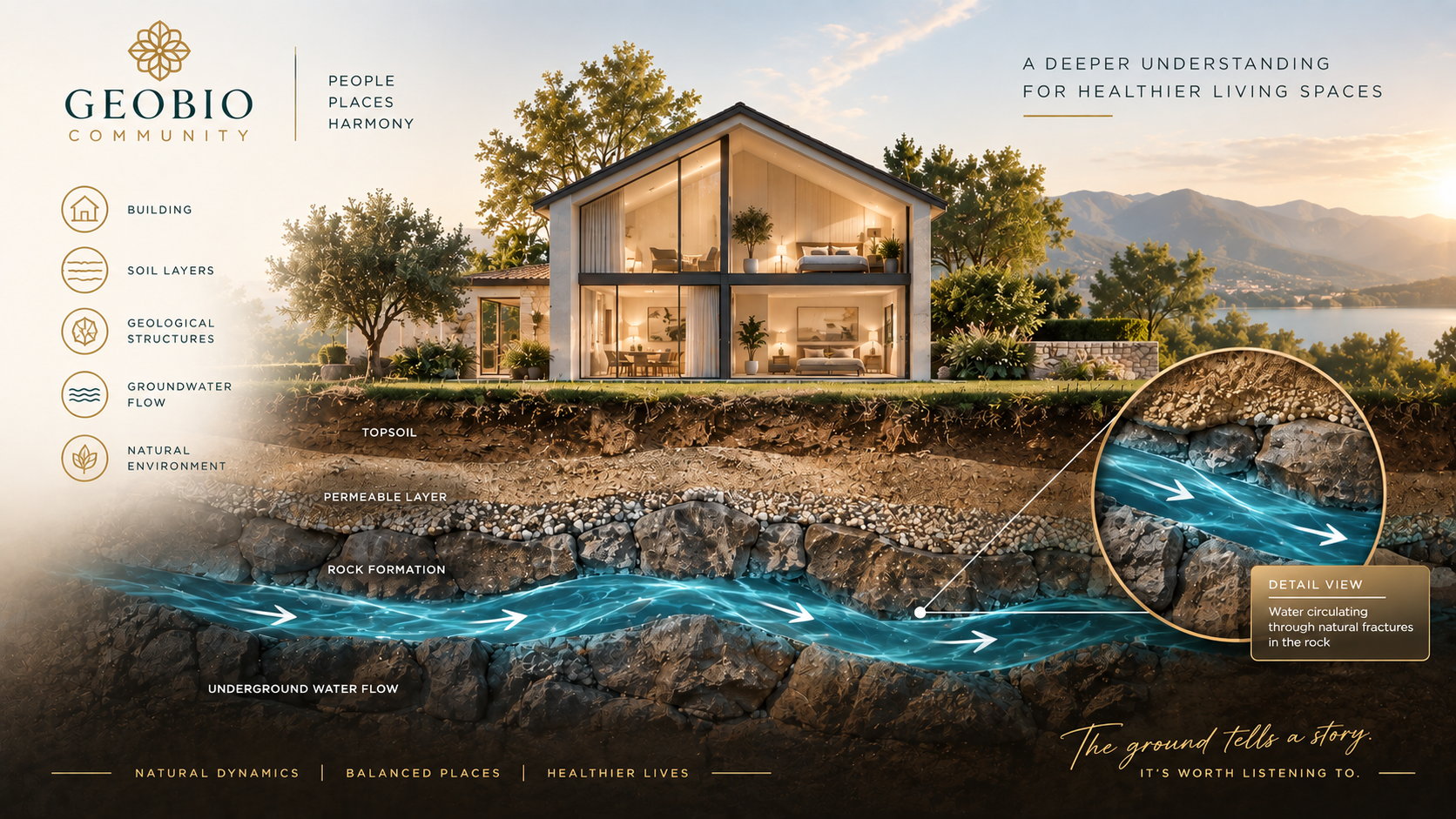
The environment of a home does not begin at its walls. Beneath every building lies a complex underground environment composed of soil, rock formations, geological structures and the movement of groundwater.
In geobiology, particular attention has traditionally been given to underground water flows and their relationship with the places where people live, work and rest.
Although these underground features are not visible from inside a home, their location and relationship with the building can be investigated as part of a broader geobiological assessment.
Understanding what lies beneath a property therefore adds another dimension to the analysis of the living environment.
| Understanding a home also means understanding the natural environment on which it stands. |
1. Understanding Underground Water Veins
The term water vein is commonly used in geobiology to describe a defined underground flow of water beneath a property or surrounding land.
Underground water does not necessarily flow through large open channels similar to rivers. Depending on the geological characteristics of the terrain, water may circulate through permeable layers, fractures, fissures and other structures within the ground.
Its path, depth, width and flow characteristics can therefore vary considerably from one location to another.
From a geobiological perspective, identifying the position of these underground water flows is particularly relevant when examining areas where people spend extended periods of time, such as bedrooms, offices and living spaces.
 |
Key Insights An underground water vein should not simply be imagined as an underground river. Water can move through different geological structures, and its characteristics vary according to the nature of the terrain. |
2. An Empirical Approach Based on Observation
Interest in underground water and its relationship with human settlements is not a recent phenomenon. Across different periods and cultures, people have observed the characteristics of the land when selecting locations for wells, buildings, settlements and agricultural activities.
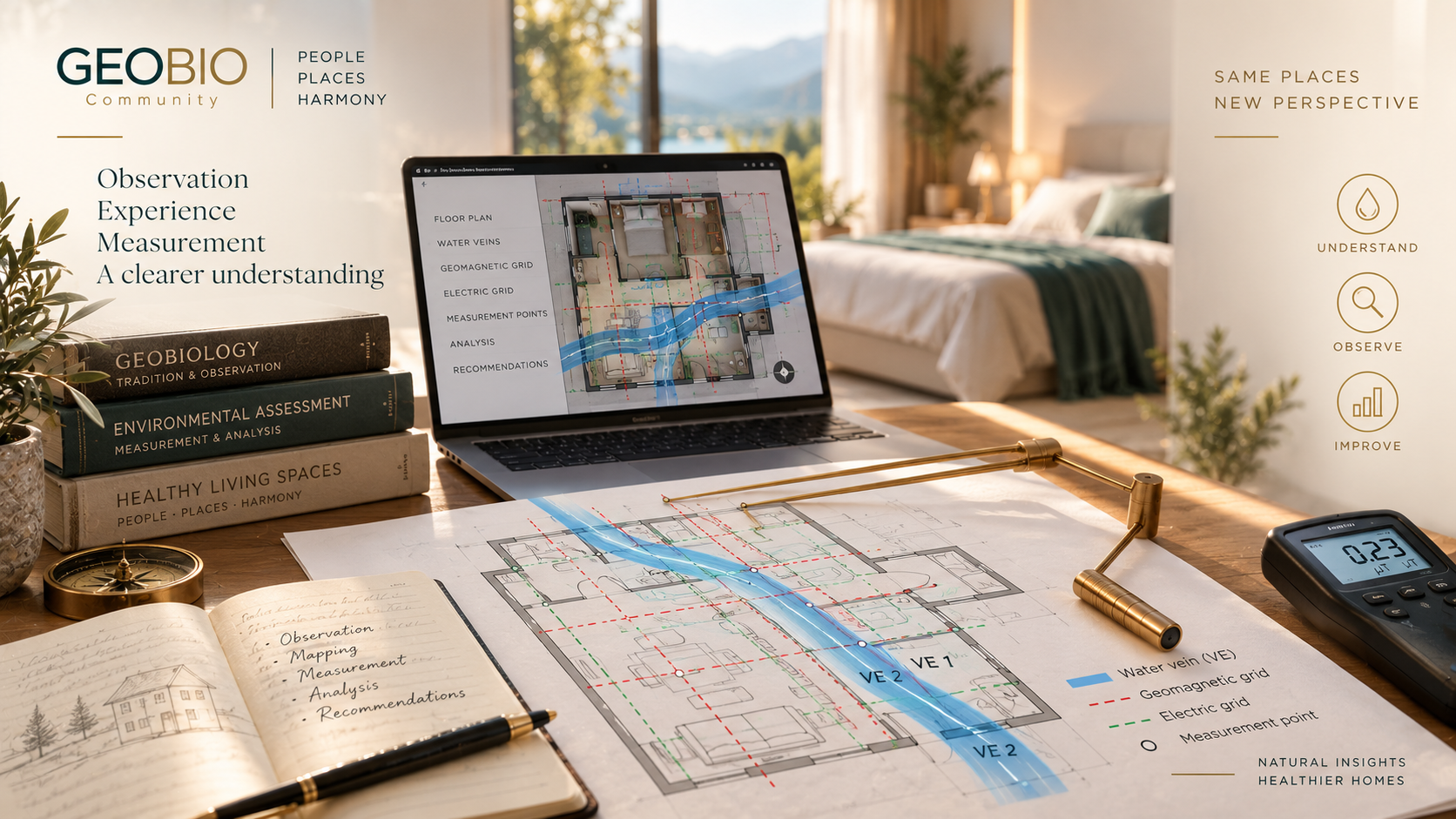
Within geobiology, knowledge has also developed through empirical observation: examining locations, identifying recurring environmental patterns and comparing them with the way particular spaces are used.
An empirical approach is based on repeated observation and experience. It does not begin with a predetermined conclusion, but with the identification of patterns that can then be investigated more systematically.
Modern geobiological practice can complement this observational approach with detailed floor plans, environmental measurements and structured documentation. This makes it possible to record findings precisely and examine them within the broader context of the property.
 |
Key Insights Empirical knowledge develops through repeated observation. A structured geobiological assessment seeks to document these observations precisely and place them within the overall environmental context of the property. |
3. Looking at the Ground as Part of the Home Environment
A water vein should never be considered in isolation. The underground environment may include geological faults, variations in soil composition, groundwater movement and other natural characteristics that together form part of the environmental profile of a property.
For this reason, a comprehensive geobiological assessment considers the relationship between what is identified beneath the building and how the spaces above it are actually used.
The position of bedrooms, beds, workspaces and frequently occupied areas can therefore be compared with the findings recorded during the investigation.
This broader approach avoids drawing conclusions from a single observation. Instead, it combines the analysis of the ground with the characteristics of the building, its internal layout and, where appropriate, objective electromagnetic and environmental measurements.

 |
Key Insights The presence of underground water is only one element of a much larger environmental picture. Its relevance can only be properly considered in relation to the building, the use of its spaces and the other environmental factors present. |
Conclusion
Every building is connected to the natural environment on which it stands. Soil composition, geological structures and groundwater movement form part of an underground environment that is usually invisible to the occupants of a home.
Geobiology provides a structured way of investigating these characteristics and examining their relationship with the spaces in which people live, work and rest.
Rather than focusing on a single phenomenon, a comprehensive assessment considers underground water as one element within a broader environmental analysis.
Observation, mapping, environmental measurements and an understanding of how the property is used can together provide a more complete picture of the living environment.
A deeper understanding of a home begins with understanding the environment above and below it.
About the Author
 |
David Georgiu is an environmental consultant specialising in geobiology and indoor electromagnetic assessments. Through GEOBIO Community, he helps homeowners and professionals better understand their living environments using a structured approach that combines scientific measurements, environmental observation and practical recommendations. His mission is to make environmental assessment accessible, educational and understandable for everyone. |
Would you like to better understand your home environment?
Discover our environmental assessment services and learn how a comprehensive evaluation can help you better understand the conditions within your home.